
What I Learned Teaching First-Time Founders to Test an Offer in 72 Hours
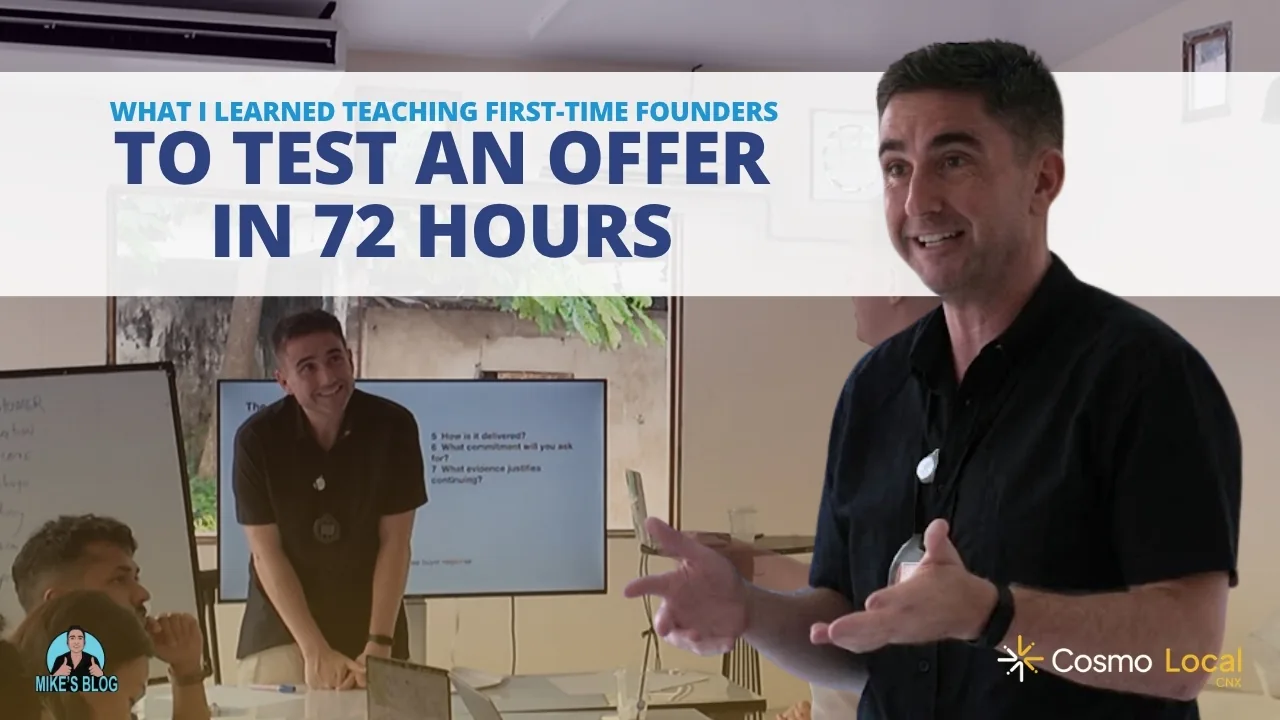
On September 14, 2026, I led a practical CosmoLocal CNX workshop in Chiang Mai called Turn Your Idea Into a Repeatable Offer and Test It in 72 Hours. The central idea was simple: an early test does not need to look like a finished company. It needs to create enough evidence to help you decide what deserves the next investment.
Before the session, I shared why I agreed to join the CosmoLocal program and what I hoped first-time founders would take away. Now that the workshop has happened, I want to share the part of the framework that is useful even if you were not in the room.
Why evidence comes before infrastructure
Founders often believe they need a website, a complete product, a polished brand, and a complicated system before they can ask anyone to buy. I understand the instinct. Building feels productive, and showing an unfinished idea can feel uncomfortable.
The problem is that private preparation can hide the most important questions. Does a specific customer care about this problem? Do they understand the offer? Will they make a real commitment? Which part do they value enough to pay for?
A useful first test brings one of those questions into the real world. It might be a paid pilot, a manual service, a preorder, a product mockup shown to target buyers, or three serious customer conversations. The test should be small enough to run quickly and real enough to teach you something.
My first ecommerce lesson was expensive and useful
I started an ecommerce venture in early 2004. Later that year, we tested bar products through a very manual fulfillment setup. For about three months, the logistics were painful and the margins were negative because we were paying for double second-day-air fulfillment.
That was not a model to keep. It was a temporary test. Real orders showed us which products people actually wanted and which listings deserved to be dropped. In early 2005, we began wholesaling the proven winners, then moved toward a third-party logistics setup and eventually direct factory sourcing.
The lesson was not that founders should lose money indefinitely. The lesson was to make the temporary test survivable, learn from real transactions, and invest in infrastructure only after the evidence tells you where it matters.
A customer helped reveal the better product
Years later, while I was working with an SEO software company in China, we had an analytics and competitor-analysis product with recurring customers but limited growth.
An inbound prospective investor and customer from Finland proposed a different direction. My partner and I met them in Europe during Chinese New Year in 2009. We kept the original product, but developed a second offer focused more directly on lead generation, landing pages, and a sales dashboard connecting traffic, conversions, leads, and sales.
Sales began coming in much more strongly. The market was telling us that reporting data was less compelling than helping customers understand and improve a commercial outcome.
That experience changed how I think about product development. Customers should not only react to something you have already built. The right customers can help you define what the product should become.
The seven questions behind a repeatable offer
During the workshop, we used the same simple canvas for services, digital offers, and physical products:
- Customer: Who is this specifically for?
- Situation: What problem, desire, or moment makes them look for help?
- Outcome: What useful change do they want?
- Package: What is included, and excluded, in version one?
- Delivery: How will the customer receive the result or product?
- Terms: What will it cost, or what commitment will the first test require?
- Proof: What is the smallest real-world evidence that would justify continuing?
Then we added one action question: Who will you ask, show, offer, or sell this to within 72 hours?
That final question matters because a framework is only useful when it changes behavior. A landing page that nobody sees is still private preparation. A mockup shown to five target buyers can create evidence. A service package offered to three relevant prospects can create evidence. A paid manual pilot can create evidence.
What I took away from teaching the room
Teaching this session reminded me that people at different stages often face the same underlying problem. One person may be choosing an idea. Another may already have customers. Both still need to decide which assumption to test next.
The answer is rarely to build everything. It is to define the decision, reduce the size and cost of the test, and put the offer in front of someone who can give meaningful evidence.
I also came away thinking more about the difference between selling yourself and building something repeatable. Custom work can be the right place to start, but a repeatable offer becomes clearer when the customer, outcome, scope, delivery, terms, and proof are defined. That clarity makes it easier to sell, deliver, improve, and eventually turn the work into an asset that can create value beyond one hour of the founder's time.
Join CosmoLocal Main Week
CosmoLocal CNX continues with Main Week in Chiang Mai from September 23 to 28, 2026. If you want to join the main conference, use coupon code MICHELINI30 for 30% off.
If you organize a conference, founder program, or company training and want a practical session built around real operator lessons, you can also see more of my work on my speaking and workshops page.
What is one assumption you could test with a real person in the next 72 hours?
Comments